
Hyderabadi vs Lucknowi vs Kolkata Biryani: What Actually Sets Them Apart

|
Key Takeaways
|
What is actually different between Hyderabadi, Lucknowi and Kolkata biryani? Most people assume it is just how spicy each one is. That is the least interesting part of the answer. The real story sits in three places: how the meat and rice meet each other, which rice you use, and one defining ingredient that each city refuses to give up.
This guide breaks down all three styles the way a veteran kitchen would explain them to a new cook. By the end, it becomes clear which one to order, which one to cook first at home, and why the rice matters more than any masala. Professional biryani kitchens across India rely on aged extra long basmati, such as India Gate Foods basmati rice, for all three styles, and the reasons ageing is non-negotiable are covered below. For a wider view of how these three fit into the country’s larger biryani map, see the guide to regional biryani styles across India.
What Is the Core Difference Between Hyderabadi, Lucknowi and Kolkata Biryani?
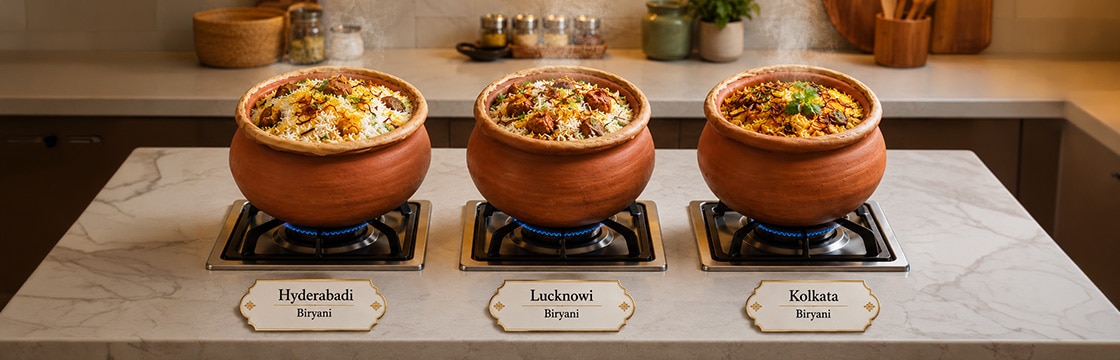
The core difference is the cooking method and the flavour philosophy. Hyderabadi biryani is usually kacchi: raw marinated meat is layered under parboiled rice and both finish cooking together under dum. Lucknowi biryani is pakki: the meat is fully cooked in its own stock first, then layered with rice for a gentle dum. Kolkata biryani follows the Lucknowi pakki method but adds a large boiled potato and often a boiled egg, with a slightly sweeter, milder profile.
| Citation capsule: Hyderabadi biryani uses the kacchi method, cooking raw marinated meat and rice together under dum, and carries bold layered spicing. Lucknowi biryani uses the pakki method with pre cooked meat and subtle aromatics. Kolkata biryani, descended from the Lucknowi style, is defined by its potato, mild sweetness and light use of rose and kewra water. All three traditionally use aged long grain basmati rice. |
| Style | Method | Rice Used | Signature Ingredient | Spice Level |
| Hyderabadi | Kacchi (raw meat + rice under dum) | Aged extra long basmati | Fried onions, mint, green chilli heat | High, layered |
| Lucknowi (Awadhi) | Pakki (meat cooked first) | Aged long grain basmati | Kewra, saffron, restrained whole spices | Mild, aromatic |
| Kolkata | Pakki (Lucknowi lineage) | Aged long grain basmati | Boiled potato and egg, hint of sweetness | Mild, slightly sweet |
What Makes Hyderabadi Biryani Different From the Other Two?
Hyderabadi biryani is different because it is the only one of the three that commonly uses the kacchi method, where raw marinated meat cooks entirely in the sealed pot along with the rice. The meat is tenderised with curd, raw papaya paste, fried onions, mint and green chillies, and everything depends on timing. If the rice finishes before the meat, the biryani fails. That risk is exactly why it tastes the way it does when done right.
Because the dum runs long and hot, the rice takes real punishment in a Hyderabadi pot. This is where grain choice stops being a preference and becomes a rule. The style demands aged extra long basmati, parboiled to about seventy percent, so it can absorb the meat juices for another twenty five to thirty minutes without collapsing.
A well aged basmati grain lengthens to nearly twice its size under dum and still stays separate, while a fresh crop grain in the same pot turns to paste. That is not the masala’s fault. It is the rice, and the full breakdown of what makes basmati rice different from other types of rice explains the grain science behind why.
The flavour profile is assertive: whole garam masala, fried onion sweetness, mint freshness, and genuine chilli heat, all in distinct layers rather than blended into one gravy. When you dig into a proper Hyderabadi biryani, the top rice is fragrant and pale, the middle is streaked with saffron, and the bottom is rich with marinade. That gradient is the whole point of kacchi cooking.
To complement each unique style, India Gate Foods offers custom spice blends tailored to specific regional variations: a dedicated Hyderabadi biryani masala for the Hyderabadi variant, a specialized Lucknowi biryani masala for the Lucknowi style, and a custom Kolkata biryani masala for the Kolkata variation.
What Makes Lucknowi (Awadhi) Biryani Different?
Lucknowi biryani is different because it takes the opposite philosophy: refinement over intensity. The meat is cooked separately in a spiced stock called yakhni until tender, then layered with partially cooked rice for a short, gentle dum. Because the meat is already done, the dum only has to marry the aromas, so it runs cooler and shorter than a Hyderabadi dum.
The Awadhi kitchens of the Nawabs believed that no single spice should announce itself. So instead of chilli heat, you get saffron, kewra water, a little cream or milk, and whole spices used with restraint. First time eaters sometimes call it bland. Give it a moment. The perfume builds as you eat, and the meat is usually softer than anything a kacchi pot produces, because yakhni cooking is far more controlled.
The rice requirement is the same family but a slightly easier job. You still want aged long grain basmati, because the grains must remain visibly separate and fully elongated, which is the visual signature of an Awadhi plate. But since the dum is gentler, the rice faces less risk. This is one of the reasons experienced cooks point beginners here first: the method forgives small mistakes that a kacchi biryani will punish.
If grain selection feels confusing at this stage, the practical walkthrough on how to choose the best basmati rice for biryani narrows it down to length, ageing and aroma in a few minutes.
What Makes Kolkata Biryani Different, and Why Does It Have a Potato?
Kolkata biryani is a child of the Lucknowi style with its own identity. When the British exiled Nawab Wajid Ali Shah from Awadh to Calcutta in 1856, his kitchen came with him, and the Awadhi pakki biryani evolved in its new home. The two changes that define it are the large boiled potato cooked in the biryani itself, and a gentle sweetness in the rice, often with a light touch of rose and kewra water and a boiled egg on the plate.
People love to repeat the story that the potato was added because the exiled court could not afford enough meat. Food historians are not fully convinced by that tale. Potatoes were a fashionable, almost exotic vegetable in Bengal at that time, and the royal kitchen likely treated them as an addition of interest, not economy. Either way, the potato earned its place: it soaks up the stock and masala until many Kolkata locals will tell you honestly that they fight over the aloo before the mutton.
The spicing is the mildest of the three, the colour is a soft yellow rather than a deep orange, and the overall effect is comfort rather than fireworks. The rice, again, is aged long grain basmati, lightly perfumed. If you serve a Kolkata biryani with proper elongated separate grains, a glistening potato and a halved egg, you have got it right.
Can the Same Rice Be Used for All Three Biryani Styles?
Yes, all three styles were built around aged, extra long grain basmati, and that is the single thread that ties Hyderabad, Lucknow and Kolkata together. What changes between the styles is not the rice variety but how far you parboil it before dum: closer to seventy percent for a long Hyderabadi kacchi dum, closer to eighty percent for the shorter Lucknowi and Kolkata dum. Getting that parboil point right starts with the fundamentals covered in the step by step guide to cooking basmati rice perfectly.
Ageing matters because rice loses moisture as it matures over one to two years. Drier, aged grain absorbs stock evenly and elongates dramatically without turning sticky, which is exactly what a layered biryani demands.
Which Biryani Should You Try First, and Which Should You Cook First? (How to Choose)
If you are ordering, choose by your palate. If you are cooking, choose by your confidence. Those are two different decisions and people mix them up all the time.
- Order Hyderabadi if you want intensity, real chilli heat and dramatic layers. It is the boldest plate of the three and the one most people picture when they say biryani.
- Order Lucknowi if you prefer aroma over heat, or you are introducing someone to biryani who does not handle spice well. It rewards slow eating.
- Order Kolkata if you want comfort and something distinct to talk about at the table. The potato and egg make it the most homely of the three.
For cooking at home, the sequence seasoned chefs recommend is fixed: Lucknowi first, Kolkata second, Hyderabadi last. Pakki methods let the cook taste and correct the meat before it ever meets the rice, so first attempts are protected. Kacchi cooking gives no second chance: once the pot is sealed, the marinade, the parboil point and the flame have already decided the result. That one has to be earned. Whichever style comes first, start with good aged basmati such as India Gate Foods extra long grain basmati varieties, because no method can rescue the wrong grain.
Frequently Asked Questions
Is Hyderabadi biryani spicier than Lucknowi biryani?
Yes, noticeably. Hyderabadi biryani carries genuine green chilli heat along with layered whole spices, while Lucknowi biryani deliberately avoids sharp heat in favour of saffron, kewra and yakhni depth. If a Lucknowi biryani burns your tongue, it has been made wrong. The two styles represent opposite philosophies: Hyderabad celebrates intensity, Lucknow celebrates restraint.
Why does Kolkata biryani have potato in it?
The potato entered when Nawab Wajid Ali Shah’s exiled Awadhi kitchen settled in Calcutta after 1856. The popular story says it stretched scarce meat, but potatoes were actually a prized novelty vegetable in Bengal then, so it was likely added for interest as much as economy. Today the stock soaked potato is the style’s defining feature.
What is the difference between kacchi and pakki biryani?
Kacchi biryani layers raw marinated meat under parboiled rice so both cook together in one sealed pot, which gives deep integrated flavour but very little room for error. Pakki biryani cooks the meat fully first, then layers it with rice for a short dum. Hyderabadi is typically kacchi, while Lucknowi and Kolkata biryani are pakki.
Can the same basmati rice be used for all three biryani styles?
Yes. All three styles were built on aged, extra long grain basmati, and a quality aged grain such as India Gate Foods basmati works across every one of them. What changes is the parboil point before dum: around seventy percent cooked for a long Hyderabadi kacchi dum, and closer to eighty percent for gentler Lucknowi and Kolkata dum.
Which biryani style is easiest to make at home?
Lucknowi is the easiest for beginners because the pakki method lets you fully cook and taste the meat before layering, so mistakes are caught early. Kolkata follows the same forgiving method with the potato added. Hyderabadi kacchi biryani is the hardest, since raw meat and rice must finish together in a sealed pot with no chance to correct anything.
Which rice grain length is best for these biryanis?
Extra long grain aged basmati is best for all three. Aged grain has lower moisture, so it elongates dramatically during dum, absorbs stock evenly and stays separate on the plate, which is the visual test of a well made biryani in Hyderabad, Lucknow and Kolkata alike. Fresh crop or short grain rice tends to clump under a long dum.
Category: Blogs