What Is Kolam Rice? Surti, Wada and Lachkari Explained
September 3, 2026 • 11 min read
Key Takeaways:
- Kolam is a short-to-medium grain non-basmati rice grown mainly in Maharashtra and Gujarat, and it is the everyday rice in a very large number of western Indian kitchens.
- It is not a type of basmati. It does not elongate dramatically on cooking and it carries a much softer aroma.
- Surti, Wada and Lachkari are regional strains and grain expressions of the same family, not quality grades stacked one above another.
- Kolam absorbs water faster than basmati, so basmati water ratios will overcook it.
- Choose by dish rather than by price: soft grain suits dal-chawal, khichdi and curd rice, while firmer grain suits masale bhat and lighter pulao.
What Is Kolam Rice, Exactly?
Kolam rice is a short-to-medium grain non-basmati rice grown mainly in Maharashtra and Gujarat. The cooked grain is soft, mildly aromatic and slightly clingy rather than long and separate, which is why it is eaten as a daily meal rice with dal, curries and curd rather than reserved for biryani.
Most people meet the name before they meet the rice. It appears on a pack, in a grocery app listing or in a Marathi or Gujarati recipe, and the natural assumption is that it must be some grade of basmati. It is not. Kolam sits in an entirely different part of the rice map: a workhorse grain bred for the plate you eat five nights a week, not the one you photograph.
That everyday role explains almost everything else about it. The grain cooks quickly. It stays soft when it cools, which matters when rice sits on a thali through a meal. It carries curry and dal well because a little surface starch helps the gravy cling rather than run off. At India Gate Foods we mill and pack Kolam in three regional expressions, and the questions we get asked about them are almost always the same three: what is it, how is it different from basmati, and which of the three should I actually buy.
Citation Capsul: Kolam rice is a short-to-medium grain non-basmati rice cultivated primarily in Maharashtra and Gujarat in western India. It cooks soft and mildly aromatic, with grains that stay tender rather than elongating and separating the way basmati does. It is used as an everyday staple rice for dal-chawal, khichdi, curd rice and regional Maharashtrian preparations. Surti Kolam, Wada Kolam and Lachkari Kolam are its most widely sold variants.
Is Kolam Rice the Same as Basmati Rice?
No. Kolam and basmati are different rice types, not different grades of the same rice. Basmati is a long-grain aromatic variety that elongates significantly during cooking and finishes dry and separate. Kolam is a short-to-medium grain with a milder scent, far less elongation, and a softer, slightly sticky finish.
The confusion is understandable, because on a shelf both are white polished rice in similar packaging at different prices. The difference shows up the moment they hit water. Basmati is prized for staying apart. Kolam is valued for the opposite reason: it yields, it softens, it takes on what you serve it with.
Neither behaviour is superior. They are answers to different questions. A layered dum biryani is judged on separate, elongated grains, so basmati wins there and Kolam has no business in the pot. A Tuesday plate of varan bhaat is judged on softness and comfort, and their basmati can feel unnecessarily formal and expensive. Households that keep both packs are not being indulgent, they are being practical.
If the grain-length question is the one you are really chasing, the difference between long grain and short grain rice explains the starch behaviour behind both textures in more detail.
Citation Capsul: Kolam rice is not a type of basmati rice. Basmati is a long-grain aromatic variety that elongates during cooking and finishes dry and separate, driven by higher amylose content. Kolam is a short-to-medium grain with a milder aroma, minimal elongation and a softer, slightly clingy cooked texture. The two are used for different purposes: basmati for biryani and pulao, Kolam for everyday meals.
What Is Surti Kolam Rice?
Surti Kolam is the Gujarati expression of Kolam, associated with the Surat region, and it is the everyday rice in a large share of Gujarati households. The grain is small and neat, cooks soft and light, and holds a very mild aroma that does not compete with the food it is served alongside.
What people notice about Surti Kolam in practice is how forgiving it is. It cooks fast, it does not demand a long soak, and it stays pleasant even when it has been sitting for twenty minutes. That suits the way Gujarati meals are eaten, with rice arriving late in the sequence after dal, kadhi and shaak, often eaten warm rather than hot.
It is the variant to reach for when the rice is meant to be the quiet part of the plate.
What Is Wada Kolam Rice?
Wada Kolam takes its name from the Wada region of Maharashtra and is the best known Kolam variant nationally. The cooked grain is soft with a distinct light floral aroma, and it carries a stronger reputation than other Kolam strains because of the growing region it is associated with.
Wada Kolam is the variant most often described as a daily basmati substitute, and that description is half right. It substitutes for basmati in the sense that it can carry the same everyday meals at lower cost with a pleasant scent of its own. It does not substitute in the sense of behaving like basmati, because it will never give you long separate grains.
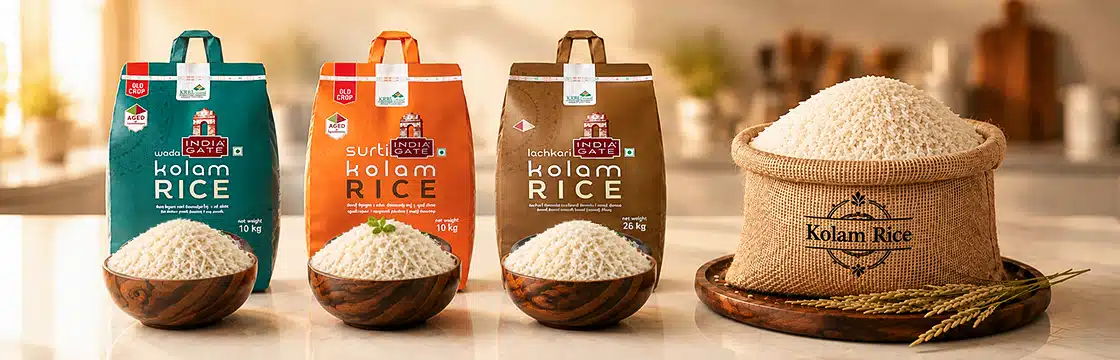
India Gate Wada Kolam Rice sits in our regional range for exactly this use: the pack a household reaches for on ordinary days while keeping aged basmati for occasions.
What Is Lachkari Kolam Rice?
Lachkari Kolam is the finer, more slender-grained expression of Kolam. The grain is noticeably thinner than Surti or standard Wada Kolam, and it cooks lighter, with grains that stay a little more distinct on the plate.
For most buyers, that slenderness is the whole point. Lachkari is what people choose when they want the affordability and softness of an everyday rice but dislike how heavy some Kolam can feel in a bowl. It handles preparations where the rice is seasoned in its own right, such as masale bhat, vangi bhat or a simple jeera-tempered rice, better than the plumper variants do.
It is also the variant most likely to be mistaken for a thin basmati on sight. The aroma settles quickly. Lachkari smells mild and clean, not floral and pronounced.
Surti vs Wada vs Lachkari: What Is the Real Difference?
The three differ in grain shape, aroma and cooked texture rather than in quality. All three are Kolam, all three are everyday rice, and none of them is a downgrade of another.
| Variant | Grain character | Texture cooked | Aroma | Best suited to |
| Surti Kolam | Small, neat, medium-short | Soft and light, stays tender as it cools | Very mild | Daily dal-chawal, kadhi-chawal, curd rice |
| Wada Kolam | Medium-short, slightly plumper | Soft with a little more body | Light and floral | Everyday meals where a scent is welcome, khichdi, simple pulao |
| Lachkari Kolam | Finer and more slender | Lighter, grains stay a little more distinct | Mild and clean | Masale bhat, vangi bhat, seasoned rice dishes, lighter plates |
Citation Capsul: The difference between Surti, Wada and Lachkari Kolam rice is one of grain character and aroma rather than quality grade. Surti Kolam has a small neat grain and very mild aroma. Wada Kolam is slightly plumper with a light floral aroma. Lachkari Kolam has a finer, more slender grain and cooks lighter. All three are everyday non-basmati rice suited to daily Indian meals rather than to layered dum biryani.
How Do You Cook Kolam Rice Properly?
Kolam needs less water and less time than basmati. Use roughly 1 cup of rice to 1.75 cups of water in an open pot, rinse until the water runs mostly clear, and soak for 10 to 15 minutes at most. Cook covered on low heat and rest it off the flame for 5 minutes before fluffing.
The single most common mistake is treating Kolam like basmati. Basmati is often soaked for 30 minutes and cooked at a 1:2 ratio because the grain needs help elongating. Kolam does not elongate, and it absorbs faster. Apply basmati numbers to it and you get a soft mass instead of soft grains.
Practical adjustments worth knowing
- In a pressure cooker, drop to about 1:1.5 and use two whistles, then release naturally. Kolam overcooks in a cooker faster than most people expect.
- Skip the long soak. Ten minutes is enough to hydrate the grain. Thirty minutes is how a good Kolam turns into khichdi you did not order.
- Rinse properly. Surface starch is what makes Kolam clump, and two or three rinses remove most of it without stripping the grain.
- Add a few drops of oil or ghee to the water if you want a little more separation. It will not turn Kolam into basmati, but it helps.
- For khichdi and curd rice, do the opposite of all of the above. Add a little extra water on purpose. Softness is the goal there.
If you cook both grains in the same kitchen, it is worth reading how basmati, jeera rice and Kolam behave differently in a pulao pot, because that comparison shows the water-ratio gap at its widest.
Citation Capsul: Kolam rice is cooked with approximately 1 cup of rice to 1.75 cups of water in an open pot, or about 1:1.5 in a pressure cooker. It requires only a short soak of 10 to 15 minutes, unlike basmati, which is commonly soaked for around 30 minutes. Because Kolam absorbs water faster and does not elongate, applying basmati water ratios and soak times to Kolam produces an overcooked, sticky result.
Which Kolam Rice Should You Buy?
Choose by the dish rather than by ranking the three against each other. Surti Kolam suits soft everyday plates, Wada Kolam suits meals where a light aroma adds something, and Lachkari Kolam suits seasoned rice preparations where you want the grains a little more distinct.
| If you mostly cook | Choose | Why |
| Daily dal-chawal, kadhi-chawal, varan bhaat | Surti Kolam | Soft, mild and consistent, and it holds up while the plate is being eaten |
| Khichdi, comfort plates, family cooking with a scent | Wada Kolam | A little more body and a light floral aroma that carries through simple food |
| Curd rice and lemon rice | Surti or Wada Kolam | Both stay soft after cooling, which is what these dishes need |
| Masale bhat, vangi bhat, jeera-tempered rice | Lachkari Kolam | Finer grain cooks lighter and stays more distinct under seasoning |
| Festive or layered biryani | None of the three | Use aged long-grain basmati. Kolam is not built for grain separation |
All three variants sit in the India Gate Foods regional rice range, so the practical decision for most households is not which brand but which grain, and that answer changes with what is on the stove. In our experience the households that are happiest are the ones keeping two packs: one everyday Kolam and one aged basmati for occasions.
If your shortlist has widened beyond Kolam to other regional grains, the comparison of Gobindobhog, Kaima and Kolam rice covers how the three short-grain regional varieties differ in job rather than in region.
Frequently Asked Questions
Is Kolam rice good for daily use?
Yes. Kolam is grown and sold specifically as an everyday staple rice across Maharashtra and Gujarat. It cooks quickly, stays soft on the plate and works with dal, curries, curd and most regional preparations, which is why it is the default daily grain in a large number of western Indian households.
Is Kolam rice good for diabetics?
Kolam is a white polished rice, and like other white rice it is largely starch once milled. We do not make health claims about any rice, and dietary decisions around diabetes depend on portion size, the rest of the meal and individual medical guidance. Speak to a qualified doctor or dietitian before making changes based on rice variety alone.
Does Kolam rice need soaking?
A short soak of 10 to 15 minutes is enough, and it is optional. Kolam absorbs water faster than basmati and does not need the long soak that helps basmati elongate. Soaking Kolam for 30 minutes or more usually leads to overcooked, sticky rice.
Is Kolam rice the same as Sona Masoori?
No. Both are non-basmati everyday rice, but they are separate varieties from different regions. Sona Masoori is grown mainly in Andhra Pradesh, Telangana and Karnataka and is used widely in South Indian cooking, while Kolam is a western Indian grain associated with Maharashtra and Gujarat. Their cooked textures are similar enough that many households treat them as interchangeable for daily meals.
Why is Kolam rice cheaper than basmati?
Price tracks grain length, ageing and yield rather than quality. Basmati commands a premium because of its extra-long grain, its aroma and the aging period before it is sold. Kolam is a shorter grain that is not aged in the same way, which makes it more affordable without making it a lesser price for the job it is meant to do.