Which Rice Is Best for Kheer? Choosing the Right Grain for Thick, Creamy Kheer
September 29, 2026 • 11 min read
A kheer that turns out thin, with grains floating in sweet milk, is rarely a milk problem. It is almost always a rice problem. The grain decides how much starch reaches the milk, and starch is what gives kheer its body.
This guide explains which rice suits which kind of kheer, payesh or payasam, why the answer is often not the long-grain basmati most households reach for first, and how to get a good result from whatever rice is already in the kitchen. At India Gate Foods, we work with basmati every day, which is exactly why we're comfortable saying where full-grain basmati falls short in a pot of milk.
Key Takeaways
- Short-grain, high-starch rice makes the creamiest kheer, because it releases starch into the milk as it softens.
- Gobindobhog is the traditional benchmark for Bengali payesh, valued for its buttery aroma and soft, starchy grain.
- Broken basmati such as India Gate Mogra is the strongest basmati-family option: the broken ends release starch while the aroma stays.
- Full-grain basmati gives a thinner, lighter kheer with separate grains, which suits some styles and disappoints in others.
- The amount of rice per litre of milk, the fat in the milk and when you add sugar matter as much as the variety.
Which Rice Is Best for Kheer?
The best rice for kheer is a short-grain, high-starch variety such as Gobindobhog, the traditional choice for Bengali payesh, or Ambemohar in Maharashtra. Broken basmati, such as Mogra, is the strongest basmati-family option because broken grains release starch quickly while keeping their aroma. Full-grain basmati works but gives a thinner kheer with separate grains.
"Best" depends on the kheer you want. A thick, spoon-coating payesh needs a grain that breaks down. A light kheer where every grain is visible needs one that holds its shape. Knowing which of the two you're after narrows the choice to one or two varieties.
What Makes Rice Good for Kheer?
Kheer is a starch dish before it is a rice dish. A rice suits kheer when it releases starch easily, softens until it partly breaks down, keeps its aroma through a long simmer, and absorbs milk evenly. These four properties explain why some grains turn creamy and others stay stubbornly separate.
Starch release
Rice starch comes in two broad forms. One gels and turns creamy when cooked; the other keeps grains firm and separate. Basmati carries more of the firm kind, which is why it cooks into distinct, fluffy grains. Short-grain varieties such as Gobindobhog carry more of the creamy kind and give it up readily into hot milk. Grain length matters too: short and broken grains expose more surface for starch to escape from. The difference between long-grain and short-grain rice follows the same logic.
Softening and partial breakdown
The body of good kheer comes from grains that soften fully and partly collapse into the milk. When they do, kheer turns thick and even. When grains resist breaking, which is exactly what good biryani rice is bred and aged to do, the milk stays thin around them. A thick kheer usually shows few whole grains. A lighter one shows every grain distinctly.
Aroma that survives the simmer
Kheer simmers for 35 to 50 minutes with cardamom, saffron and caramelising milk solids. A mild rice disappears under all that. Aromatic varieties such as Gobindobhog, Ambemohar and basmati keep their fragrance, which is why they are prized for kheer even when a plainer rice would thicken just as well.
How the grain absorbs milk
Rice absorbs milk more slowly than water, partly because milk fat coats the grain. Kheer therefore takes longer than plain rice and benefits from low heat. Full-fat milk carries released starch better and reduces to a richer body than toned milk, so the same rice gives a noticeably thinner kheer in low-fat milk.
Which Rice Varieties Work Best, and for Which Kheer?
Gobindobhog and broken basmati give the thickest kheer, Ambemohar and Kolam give a soft, homely one, seeraga samba suits lighter payasam, and full-grain basmati gives a thin kheer with separate grains. The table below compares all five. For wider context on these grains, see our guide to rice varieties across India.
| Rice | Grain character | What it does in milk | Best suited to |
| Gobindobhog | Short, plump, aromatic, high in starch | Breaks down readily; thick, creamy body | Bengali payesh, thick kheer |
| Mogra (broken basmati) | Broken basmati pieces, aromatic | Releases starch fast; thick with basmati aroma | Everyday and large-batch kheer |
| Ambemohar or Kolam | Short to medium, soft-cooking | Softens well; creamy, homely texture | Maharashtrian and Gujarati kheer |
| Seeraga samba (jeera rice) | Very small, fragrant, holds shape | Grains stay intact; milk thickens slowly | Lighter South Indian payasam |
| Full-grain basmati | Long, firm, non-sticky | Stays separate; lighter, thinner kheer | Light kheer with visible grains |
Gobindobhog is the reference point because it does everything kheer needs at once: releases starch, breaks down and carries a warm, buttery fragrance. Its limitation is availability outside eastern India.
Mogra basmati rice is broken basmati, the pieces separated during milling. Breakage exposes the starchy interior, so it thickens milk almost as well as a short-grain rice while tasting and smelling like basmati. It is also economical, which matters when the kheer is for a crowd.
Ambemohar is known for its mango-blossom fragrance and fragile grain that breaks easily, which suits kheer well. Kolam cooks soft and is a practical everyday option in western India, though its aroma is milder.
Seeraga samba is fragrant but its tiny grains hold their shape, so the payasam stays lighter unless simmered longer. Full-grain basmati is the outlier: excellent rice, wrong structure for classic thick kheer.
Can You Use Basmati Rice for Kheer?
Yes, you can use basmati rice for kheer, but full-grain basmati produces a lighter kheer with distinct grains rather than a thick, even one. That suits a lightly set or festive kheer where visible grains are the point. It disappoints if you want the dense, spoon-coating body of Bengali payesh.
The reason is the same quality that makes basmati good for biryani. Its grains are firm, higher in the starch that keeps them separate, and in aged basmati they are even more resistant to breaking. In milk, that means they swell and lengthen but hold on to most of their starch.
Two simple workarounds help. Crush about a quarter of the soaked grains with your fingers or pulse them briefly before cooking, so the broken pieces thicken the milk while the rest stay whole. Or extend the simmer and press some cooked grains against the side of the pan. Both work because they do by hand what broken basmati does naturally.
Phirni is a separate case. It uses coarsely ground rice rather than whole grains, so almost any aromatic rice works once ground, including full-grain basmati.
What Is Gobindobhog Rice and Why Is It Used for Payesh?
Gobindobhog is a short-grain aromatic rice grown mainly in West Bengal, known for its buttery fragrance and high starch. It is the traditional rice for Bengali payesh because the grain softens and partly dissolves in milk, giving payesh its thick, creamy body while the aroma carries through.
Its reputation is about how the grain behaves, not regional loyalty. Any rice with the same short, starchy, aromatic profile gives a similar result, which is why Ambemohar and broken basmati are sound substitutes where Gobindobhog is hard to find. For a closer look at how it differs from other short-grain rice, see Gobindobhog compared with Kaima and Kolam rice.
How Much Rice Should You Use per Litre of Milk?
A working range is 40 to 60 grams of rice per litre of full-fat milk, roughly a quarter cup. Towards 60 grams gives a thicker, grain-forward kheer. Towards 40 grams gives a milk-forward kheer that needs a longer reduction to thicken. Go up to about 75 grams only for a very dense payesh.
The right amount moves with four things: the fat in your milk, the heat, the width of the pan and how long you're willing to reduce. Low-fat milk needs more rice or more time. A wide pan evaporates faster than a deep one. Soaked rice absorbs milk sooner, so the simmer shortens by a few minutes.
Rice quantity also matters when cooking for a group. A litre of milk with 50 grams of rice typically serves four to five small bowls. For bigger batches and plain-rice planning, our guide on how much rice per person covers the scaling.
How Should You Cook Rice for Kheer?
Rinse the rice briefly, cook it straight in full-fat milk on low heat, stir often, and add sugar only after the grains are completely soft. Adding sugar too early is the most common reason kheer stays thin, because sugar draws moisture and stops the grains swelling further.
- Rinse the rice. Rinse the rice two or three times until the water runs mostly clear. Soak for no more than 15 to 20 minutes, or skip soaking. A long soak fills the grain with water, and it then gives up less starch to the milk.
- Bring the milk to a boil. Use full-fat milk in a heavy-bottomed, wide pan. Bring it to a boil, then lower the heat.
- Add the rice to the milk. Add the drained rice directly to the milk rather than pre-boiling it in water. Starch released into water is starch lost from the kheer.
- Simmer low and stir. Keep the heat low and stir every few minutes, scraping the base. Stirring keeps released starch moving through the milk and prevents scorching. Most kheer needs 35 to 50 minutes.
- Add sugar only after the rice is soft. Add sugar once the grains are fully soft and starting to break down. Sugar draws moisture and slows further swelling, so adding it early leaves the grains firm and the kheer thin.
- Finish with aromatics. Add cardamom, nuts and saffron at the end. If using jaggery or nolen gur, take the pan off the heat and let it cool slightly first, as jaggery can split hot milk.
- Some cooks thicken kheer with a spoon of rice flour, a little semolina or a handful of crushed grains. These are legitimate shortcuts, not cheating, and useful when the rice in the kitchen is full-grain basmati.
Which Rice Should You Choose for Your Kheer?
Choose by the kheer you want, not by which rice is "best" in general. Short-grain aromatic rice suits thick payesh, broken basmati suits everyday and crowd-sized kheer, and full-grain basmati suits a lighter kheer with visible grains.
| If you want | Choose | Why |
| Thick Bengali payesh | Gobindobhog, or Ambemohar as an alternative | Starchy grain dissolves into the milk; strong aroma |
| Quick everyday kheer | Mogra (broken basmati) | Thickens fast, cooks quicker, basmati fragrance |
| Festival kheer for a crowd | Mogra (broken basmati) | Consistent thickening at volume and economical per kilo |
| Light, set kheer with visible grains | Full-grain basmati | Grains stay separate and elongated |
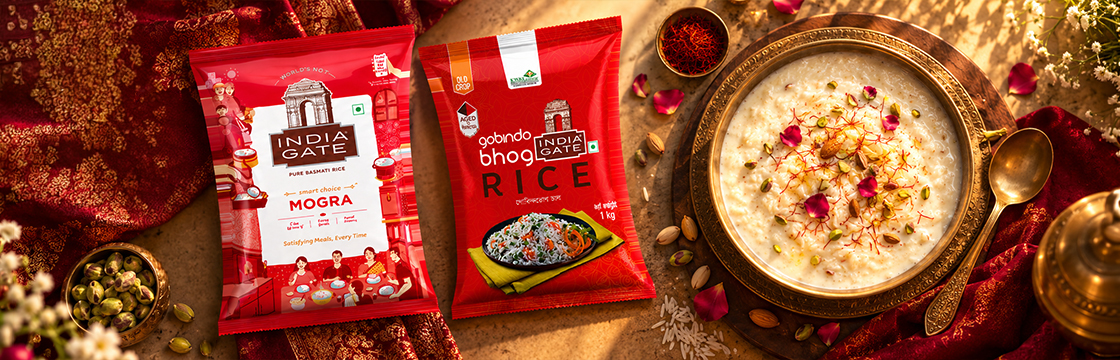
For everyday and large-batch kheer, we recommend broken basmati such as India Gate Mogra, which gives you basmati aroma with the starch release kheer needs. When a whole-grain look is the goal, full-grain India Gate basmati does that job well.
A rice that is willing to break down makes good kheer. Once you know that, you can pick the right grain in any shop, under any brand, and fix a thin kheer before it reaches the table.
Frequently Asked Questions
Can I use leftover cooked rice for kheer?
Yes, and it makes a quick kheer in about 15 to 20 minutes because the grain is already soft. Mash a portion of it into the milk to release starch. The result is less silky than kheer started from raw rice, and the leftover rice should have been cooled and refrigerated promptly after cooking.
Is Gobindobhog rice the same as Kalijira rice?
No. Gobindobhog is a short-grain aromatic rice from West Bengal. Kalijira is a much smaller aromatic grain associated with Bangladesh, sometimes sold as "baby basmati". Both are used for payesh and both suit kheer, but they are different varieties.
Why did my kheer turn out watery?
The usual causes are too little rice for the volume of milk, whole long grains that hold on to their starch, toned or low-fat milk, adding sugar before the rice softened, or not reducing the milk long enough. Fix it by simmering longer and crushing a few cooked grains against the side of the pan.
Should kheer rice be soaked before cooking?
A short soak of 15 to 20 minutes is enough, and skipping it is fine. Long soaks let the grain fill up with water, so it releases less starch into the milk and the kheer thickens more slowly.
Can I use broken basmati rice for kheer?
Yes. Broken basmati, such as Mogra, is one of the better choices for kheer. The broken ends release starch quickly and thicken the milk, while the grain still carries basmati's aroma. It also cooks faster than full grains.
Which rice is used for South Indian rice payasam?
Most Tamil and Kerala households use raw rice, known as pachari, usually a short or medium grain that softens well in milk. Some families use seeraga samba for its fragrance. Kerala's palada payasam is different: it uses rice flakes called ada rather than whole grains.